


The GS Yuasa Group recognizes that climate-related issues are one of our important management issues. In December 2019 we announced our support for the recommendations of the Task Force on Climate-related Financial Disclosures (TCFD), and we are working on climate-related information disclosure based on the TCFD framework.
In FY2026, we revised certain aspects of our TCFD disclosures to reflect the strategies set forth in the Seventh Mid-Term Management Plan.
GS Yuasa International Ltd., our core operating company, plans and implements responses to climate change in the Group. The company’s Board of Directors supervises the entire Group, receiving regular progress reports from GS Yuasa International Ltd. and providing guidance as necessary.
Policies, targets, and important topics related to the environment are formulated and deliberated upon by the Sustainability Promotion Committee and reported to the Sustainability Committee, chaired by a director, or to the Corporate Executive Management Meeting, which is headed by the president.
[Engages in deliberation and discussion at least once every three months]

Approves proposed responses to environmental issues (including climate change), receives status reports, and monitors and oversees progress

Directors and auditors
[Engages in deliberation several times annually]

Discusses proposed responses to environmental issues (including climate change)

Directors and auditors
[Engages in deliberation several times annually]

Deliberation on sustainability management issues and initiatives

Directors and auditors
[Engages in deliberation once every three months]

Formulates and discusses proposed responses to environmental issues (including climate change) and manages the progress of responses

Director in charge of sustainability promotion, sustainability promotion managers of each division and each business office
|
Meeting entity |
Topics reported, deliberated, and discussed |
|
Board of Directors |
● Formulation of the Fundamental Environmental Policy ● Establishment of the GY 2030 Long-Term Greenhouse Gas Targets ● Disclosure of business strategies based on the TCFD ● Renewable energy procurement policy ● Setting of carbon neutrality targets ● Establishment of a materiality response plan, including the environmental targets set forth in the Seventh Mid-Term Management Plan |
|
Management Meeting, Sustainability Committee, Sustainability Promotion Committee |
● Endorsement of TCFD recommendations and membership of the TCFD Consortium ● Introduction of internal carbon pricing (ICP) ● Introduction of in-house solar power generation ● Responding to customer demand regarding renewable energy procurement ● Making investment decisions regarding, and monitoring the progress of, energy conservation measures at our factories ● Formulation of environmental targets in the Seventh Mid-Term Management Plan |
Risks and opportunities are identified and evaluated through the process described below. Identified risks and opportunities, and the responses to them, are managed under our governance structures, including the Sustainability Promotion Committee.
In FY2021, each business division and management division established a project team to conduct companywide analysis of scenarios and examine countermeasures.

Identification of risks and opportunities relating to climate pursuant to the TCFD framework

Evaluation of the degree of impact of the identified risks and opportunities using companywide risk management criteria

Identification of significant risks and opportunities for which the degree of impact is particularly large and investigation of responsive measures
Main scenarios used in scenario analysis*1
|
Temperature increase |
Main scenarios used |
Overview |
|
1.5℃ |
IEA*2 Net Zero Emissions by 2050 Scenario (NZE Scenario) |
A scenario indicating what the world (policies, technologies, markets, etc.) needs to look like in order to achieve net zero global greenhouse gas (GHG) emissions by 2050 (assumed through a backcasting method) |
|
IPCC※3SSP※41-2.6 Scenario |
SSP 1-2.6: A scenario for the introduction of climate policies to limit future temperature increases to less than 2°C under sustainable development used in the IPCC Sixth Assessment Report |
|
|
NGFS*5 Net Zero 2050 Scenario |
A scenario that limits global warming to 1.5°C and achieves net-zero global CO₂ emissions by 2050 through stringent emissions-reduction policies and technological innovation |
|
|
3℃ |
IEA Stated Policies Scenario (STEPS) |
A scenario based on energy and climate policies previously implemented and individual policies that are currently being implemented by individual governments |
|
IPCC SSP 5-8.5 Scenario |
SSP 5-8.5: A scenario with no climate policies used in the IPCC Sixth Assessment Report |
|
|
NGFS Current Policies Scenario |
A scenario in which only currently implemented policies are maintained, resulting in increased physical risks |
*1 Scenario analysis uses the scenarios of public agencies and may differ from actual future social conditions.
*2 International Energy Agency
*3 Intergovernmental Panel on Climate Change
*4 Shared Socioeconomic Pathways
*5 Network for Greening the Financial System
Note: In addition to the main scenarios, this analysis made limited use of the following scenarios as supplementary inputs for the calculations:
- IEA Announced Pledges Scenario (APS): A scenario that considers all climate-related commitments made by national governments, including NDCs and long-term net-zero targets, and assumes that they are fully achieved by their target dates
- IEA Beyond 2°C Scenario (B2DS): A scenario that assumes a higher deployment of technologies in the innovation pipeline than in the 2°C Scenario (2DS)
- IEA Reference Technology Scenario (RTS): A scenario that considers the emissions-reduction and energy-conservation measures committed to by each country, including draft pledges
|
Short term |
Medium term |
Long term |
|
|
End year |
Next fiscal year |
2030 |
2050 |
|
Reason for adoption |
Seventh (FY2026–2028) mid-term management plan periods |
Achievement period of the GY 2030 Long-Term Greenhouse Gas Targets and SDGs |
Achievement period of the GY 2050 Carbon Neutrality Target |
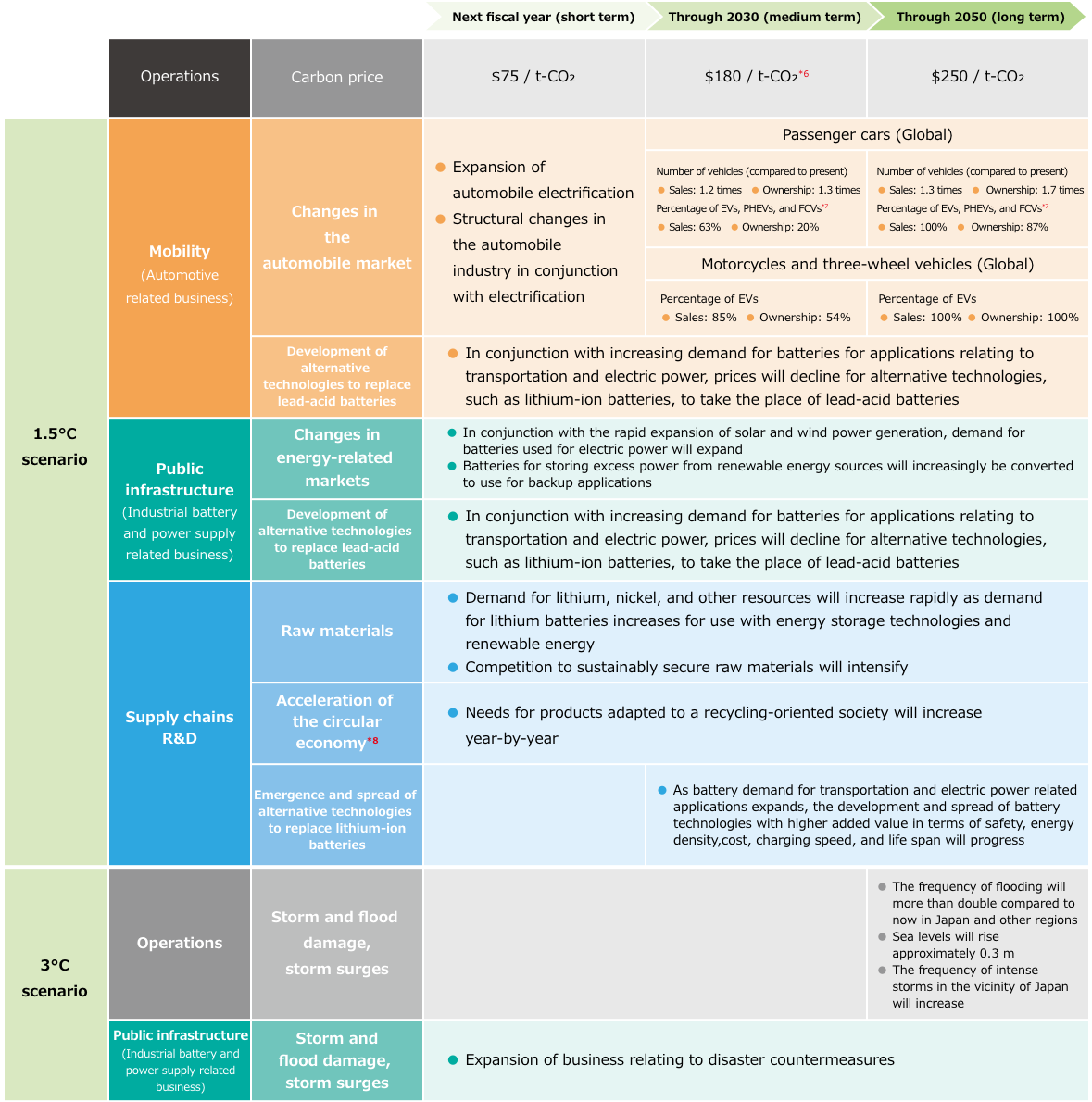
*6 2035 figures cited from the IEAʼs WEO 2025
*7 EV: Electric Vehicle; PHEV: Plug-in Hybrid Electric Vehicle; FCV: Fuel Cell Vehicle
*8 An economic mechanism for the circulation of resources without waste. Positioned as a medium- to long-term economic growth policy, particularly in European
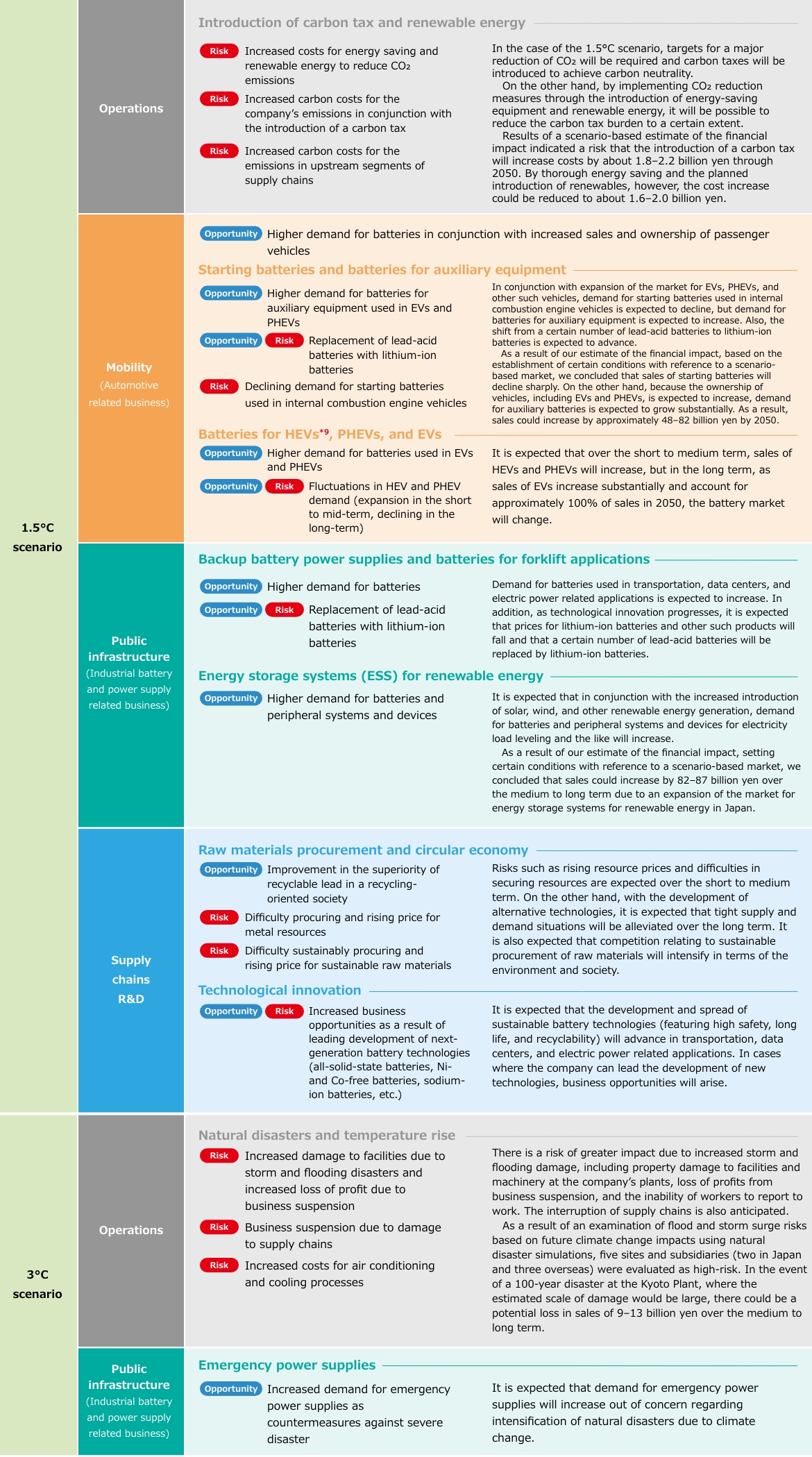
Note: Those items that were determined in the risk assessment to be of particular importance in the short to long term are listed.
*9 HEV: Hybrid Electric Vehicle
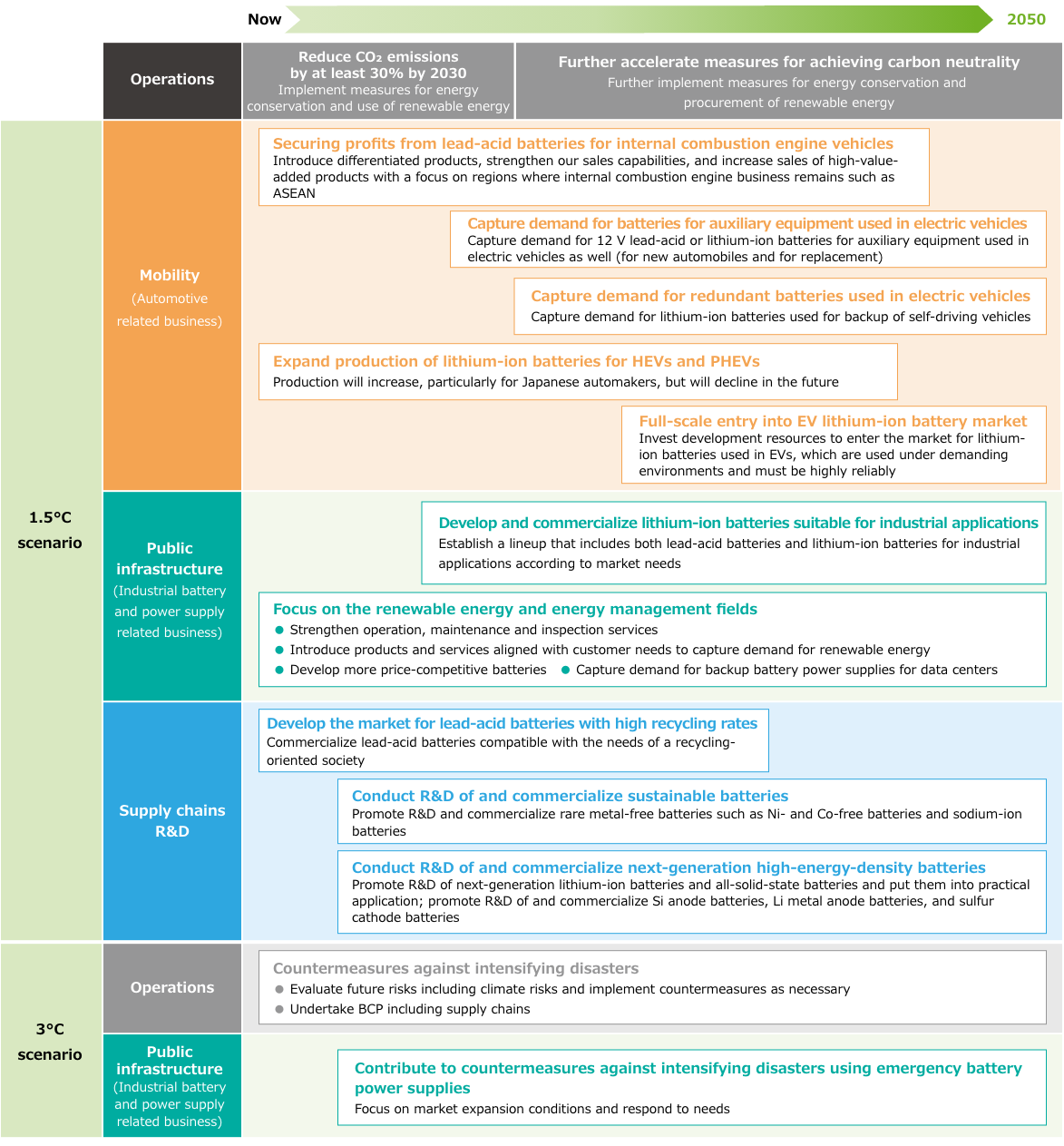
CO₂ emissions (compared with FY2018)
Reduce by at least 24%

Water intake (compared with FY2018)
Maintain a level equivalent to 15% of the FY2018 level

Percentage of environmentally considered products in total sales of all products
50% or more

Ratio of recycled lead used as lead raw materials in lead-acid batteries
75% or more

2030 (compared with FY2018) Reduce by at least 30%
2050 Carbon neutrality

The price will be set at ¥15,000/t-CO₂
Use as reference information when making
investment decisions regarding energy-saving
and renewable energy measures